A Palestinian Nurse Noticed I Was Wearing a Hostage Dog Tag. “Look,” She Said – “I Have One Too”
When a psychologist from Gaza, a nurse from Bethlehem with a hostage dog tag, and doctors from Tel Aviv meet, beautiful things happen. This isn’t a series on Kan 11—I saw it with my own eyes.
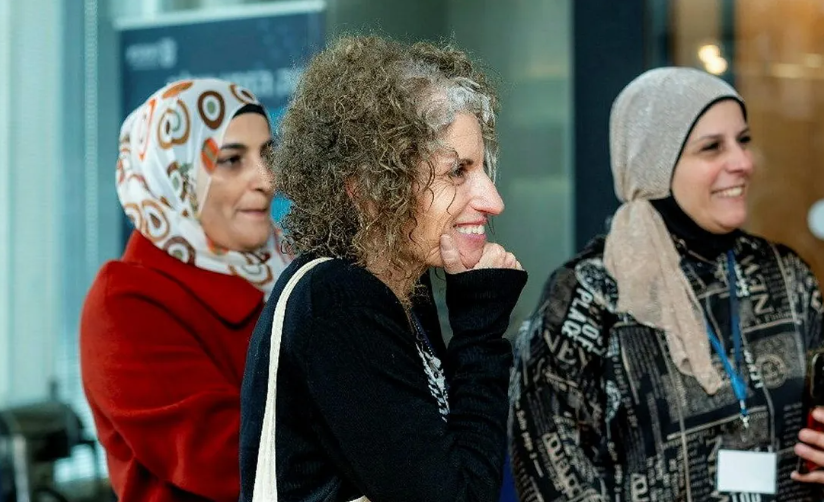
Palestinian and Israeli health professionals at Rozana's Hackathon
By Bari Danino
Haaretz Magazine
29 January 2025

"There are no skyscrapers like these in Bethlehem," the Palestinian participants told me as they rushed to take pictures with the Tel Aviv skyline seen from the windows of the 29th floor of a city-center tower.
This happened about two weeks ago. In the middle of the war, at a time when the suffering of both peoples was at its peak, a hackathon was held in Tel Av bringing together Israeli and Palestinian medical professionals. Participants arrived from all over Israel and Palestine—from Tel Aviv, Haifa, Jerusalem, Bethlehem, and Hebron. Even 'A,' a nurse and psychologist from Gaza, participated via Zoom.
It was our first face-to-face meeting. Before this, we had worked together remotely over Zoom, developing medical technology applications. The participants included professionals from fields such as medicine, nutrition, psychology, occupational therapy, and nursing. Over the course of our meetings, we brainstormed, planned, and ultimately prepared project presentations, including economic feasibility assessments.
The hackathon and the preceding meetings were organized by two NGOs—Tech2Peace and Rozana—and funded by USAID, the U.S. Agency for International Development.
Tech2Peace provides training in high-tech and entrepreneurship alongside dialogue about the Israeli-Palestinian conflict for young people from both communities. Partnering with leading organizations such as Microsoft, Google for Startups, MIT, and others, Tech2Peace hosts training programs and seminars to create mixed work teams, fostering an environment where participants can safely express their opinions and ideas.
Rozana has been working for over a decade to foster Israeli-Palestinian cooperation in the medical field. It was founded following an incident that highlighted the gap between the Palestinian and Israeli healthcare systems: when four-year-old Rozana Salawhi fell from a high floor in her home in Ramallah, she suffered life-threatening injuries. Her mother, journalist Maisa Abu-Ghanem, managed to transfer her to Hadassah Hospital in Israel, believing her chances of survival would be higher in the Israeli healthcare system. Australian businessman Ron Finkel heard about the case and recognized the potential of cooperation between Palestinian and Israeli medical professionals. This realization led to the founding of Project Rozana, which now facilitates joint training programs, hospital-based educational initiatives, and collaborative projects between Israeli and Palestinian healthcare workers.
The organizations have since built a network of hundreds of alumni, many of whom maintain connections beyond the formal programs.
"People spoke about the Nakba, the Holocaust, the kibbutzim, and October 7. Both sides shared their pain—each acknowledging their own suffering without diminishing the other's."
- Maya Arnon, the medical director of Project Rozana
Healthcare as a Bridge for Peace
Medicine naturally serves as fertile ground for forging connections. As medical professionals, we have one overriding commitment that transcends all others: the health of our patients. This principle also breaks down barriers within Israel itself—medical teams from all backgrounds—Jews, Arabs, secular, religious, and ultra-Orthodox—work together in most hospitals as equals.
This shared commitment can also be leveraged to bridge the gaps between the Israeli and Palestinian healthcare systems, breaking down walls and planting seeds of hope with our neighbours beyond the fence. That is precisely the goal of this and similar projects.
A significant part of the hackathon was dedicated to building new relationships. During breaks, we discussed ways to identify gaps in knowledge and resources in the Palestinian healthcare system, with an eye toward addressing these needs in future joint meetings—including at Israeli hospitals. By the end of the event, we had exchanged contact information and scheduled future Zoom meetings to continue our collaboration.
"There was an open dialogue," summarized Maya Arnon, the medical director of Project Rozana and one of the event's initiators. "People spoke about the Nakba, the Holocaust, the kibbutzim, and October 7. Both sides shared their pain—each acknowledging their own suffering without diminishing the other's."
A Gazan Psychologist's Perspective
'A,' the nurse and psychologist from Gaza, had also participated in the preparatory sessions in the weeks leading up to the hackathon, where teams planned their medical technology applications. Two weeks ago, he joined the event from a virtually empty hospital room in Gaza, surrounded by white walls—the only available space with an internet connection. Despite the intermittent connectivity, he actively participated, presenting his team's project, answering judges' questions, and observing other teams' presentations.
His team’s project focused on developing an app that tracks "patients' emotional states"—monitoring feelings of weakness, energy levels, and mood. The app compiles this data and provides caregivers with a numerical score, offering them an additional tool for holistic patient care. The accumulated data can also serve as a valuable resource for future research.
When asked why he chose to participate in a joint Israeli-Palestinian project, he explained:
"I previously took part in a joint course for Israelis and Palestinians at the Hadassah Binational School for Psychotherapy, which focused on the effects of war and terrorism on young people and children. I have friends and mentors from Israel. I believe we need to live together and share our thoughts and ideas in all fields."
A Palestinian Nurse’s Story
During the lunch break, 'P,' a nurse from Bethlehem, noticed my chain. The hostage dog tag was tucked inside my shirt, with only a small part of the chain visible. She asked if it was a tag supporting the hostages, and when I confirmed, she revealed that she, too, had one—given to her by an Israeli colleague.
A few days after the hackathon, I contacted the event organizers to ask for her details. I wasn’t sure she would agree to talk, and I made it clear that the conversation could be published in an Israeli newspaper. She agreed, though she requested anonymity.
Our conversation took place the day after the IDF launched Operation Iron Wall in Jenin and set up new checkpoints across the West Bank.
“How was your journey home today?”
"I'm exhausted. I left work at 3:30 PM and got home at 7 PM." (The distance between Bethlehem and Jerusalem is about 10 km.) "My friends and I were surprised and disappointed. We were sure that once the ceasefire took effect, life would return to normal for us too."
“Why did you choose to participate in this project? “
"When I was a child, my mother was friends with Israeli women. We used to bring them vegetables she picked from the fields near our home. I remember tasting sweets at their houses that I had never seen before. I’ve always been curious about Jewish life. Over the years, I’ve participated in professional workshops with Israelis, but I never really formed meaningful personal connections. When I heard about Project Rozana, I was excited about the opportunity to meet women like me who want peace."
“Did you feel safe in Tel Aviv?”
"I feel safer in Tel Aviv than on my way home. Here, I'm afraid of settlers who stop us and threaten us. The media on both sides does a terrible job—it hides what’s happening and doesn’t reflect the full truth. Until the Rozana meetings, I assumed that everyone living in a kibbutz was a settler. Only this year did I realize that many kibbutz members are actually peace activists like me. Just so you know—people in Bethlehem are optimistic. After the war, everything will work out."
---
Bari Danino is the Deputy Head of the Pediatric Orthopedics Department at Dana-Dwek Children's Hospital in Tel Aviv and a lecturer at Tel Aviv University’s School of Medicine.